How to Integrate OpenAI & AI APIs into Existing Web Applications (Security, Caching & Streaming UX)
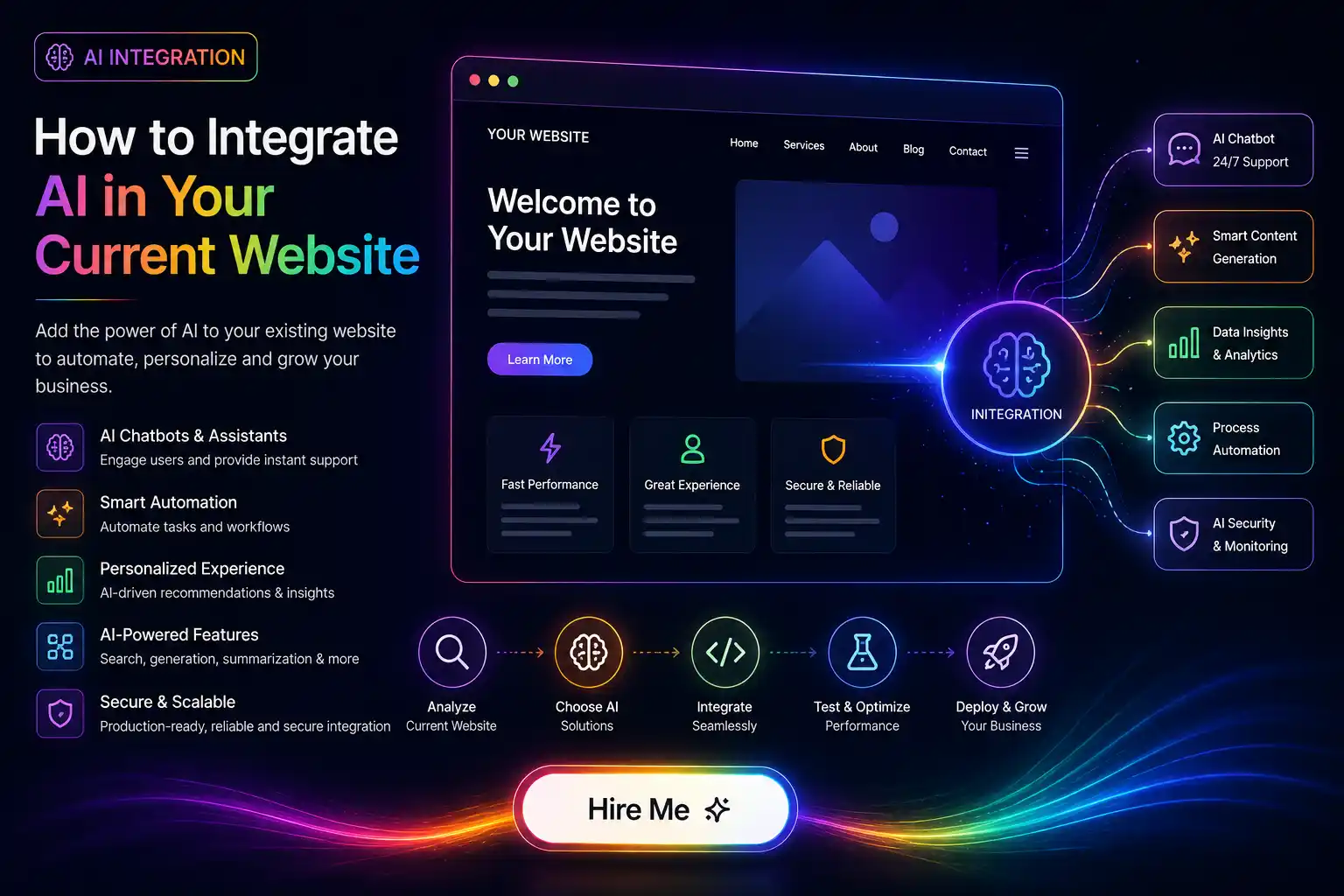
Practical AI Use Cases for Web Applications
Rather than adding generic chat widgets, the highest ROI AI integrations focus on solving specific operational bottlenecks within existing software:
Examples include automated invoice and receipt parsing into structured database records, intelligent support ticket categorization and triage, automated draft responses for customer service reps, and semantic natural language search across complex product databases.
Secure API Architecture & Token Optimization
Never expose AI API keys on the client side. All requests must route through secure backend proxies (such as Next.js Route Handlers or Laravel API controllers) with strict rate limiting, user quota tracking, and input sanitization.
To manage API costs effectively, implement prompt caching and semantic response caching with Redis, ensuring identical queries are answered instantaneously without incurring third-party API token costs.
Implementing Low-Latency Streaming Responses
Waiting 5 to 10 seconds for a full AI response creates a sluggish user experience. By utilizing Server-Sent Events (SSE) and the Vercel AI SDK or native Web Streams, AI responses can stream token-by-token directly to the user's screen in under 300ms.
This immediate feedback keeps users engaged and makes the application feel responsive and fluid.
Grounding Answers with RAG (Retrieval-Augmented Generation)
To eliminate hallucinations and ensure the AI answers questions accurately based solely on your company's proprietary documentation, we implement Retrieval-Augmented Generation (RAG).
Customer documentation and knowledge bases are chunked, vectorized using OpenAI embedding models, and stored in vector databases (such as pgvector or Pinecone) to retrieve precise contextual snippets before the prompt is evaluated.
Data Privacy & Enterprise Compliance
Commercial AI integration must adhere to strict data privacy standards. By utilizing enterprise API endpoints with zero-retention policies, customer data is never stored or used for public model training.
Combined with Personally Identifiable Information (PII) redaction filters before API transmission, your business remains fully compliant with privacy regulations.
Need Engineering Review for Your Project?
Written by Prakash Solanki • Senior Full Stack & AI App Engineer
Adding AI capabilities to your existing software doesn't require a total rebuild. Explore our AI Integration Services to learn how we can prototype and launch intelligent AI features in your application within weeks.