How to Take a Vibe Coded App to Production: The Engineering Checklist
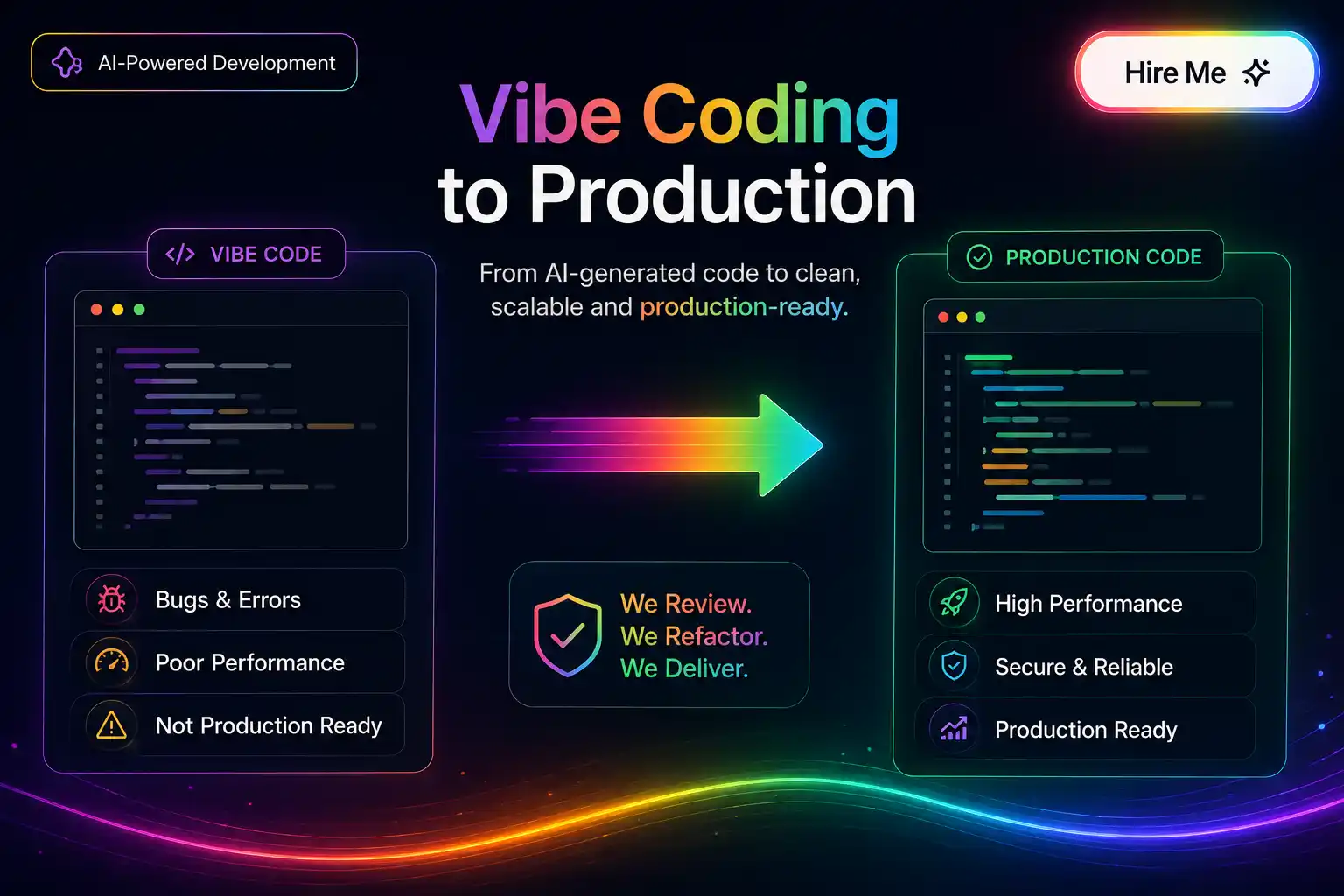
The Rise of Vibe Coding & The Prototype Trap
Vibe coding allows founders to build by prompting in natural language. It delivers unmatched speed for validating ideas and generating user interfaces. But AI models optimize for plausible completion of individual prompts rather than holistic system architecture.
As a project accumulates dozens of prompts, subtle architectural disconnects emerge: duplicate helper functions, conflicting state management patterns, unsecured API routes, unindexed database queries, and missing error boundaries.
Common Hidden Risks in AI-Generated Applications
In reviewing dozens of AI-assisted codebases, the most frequent failure points in production are not visual defects, but invisible architectural oversights:
- Client-side API key leakage: Exposing OpenAI, Stripe secret keys, or database credentials in client bundles
- Missing Row-Level Security (RLS) & authorization: Relying solely on UI hiding rather than backend database policies
- Unhandled async race conditions: Concurrent state mutations triggering inconsistent user records
- Overloaded client component trees: Sluggish mobile rendering caused by missing Server Components in Next.js
- Silent API error suppression: Empty catch blocks that leave users stranded on blank loading states
The 6-Step Production Hardening Checklist
To transition an AI-built application into reliable production software, follow a structured stabilization pipeline:
1. Dependency & Secret Audit: Verify environment variables and remove unused npm packages. 2. Manual User Journey Testing: Test destructive actions, edge inputs, and network disconnections. 3. Schema & Query Review: Add foreign keys, database indexes, and pagination. 4. Auth & RBAC Hardening: Enforce server-side role verification. 5. Error Boundary Logging: Implement structured telemetry (Sentry/LogRocket). 6. CI/CD & Zero-Downtime Deployment: Automate builds, typechecks, and automated regression suites.
Locking Down Authentication & Database Rules
Never assume authentication equals authorization. A user being logged in does not automatically prevent them from accessing another tenant's records by manipulating URL parameters or API requests.
Ensure all database queries enforce tenant isolation at the server or database policy layer, and ensure all webhook endpoints (such as Stripe or Resend callbacks) verify cryptographic signatures.
Optimizing State, Queries & Core Web Vitals
AI tools frequently generate monolithic components that re-render excessively on every keystroke. Refactoring state into isolated stores (or leveraging useSyncExternalStore and server components) reduces bundle sizes and eliminates input latency on mobile devices.
When to Bring in an Experienced Full-Stack Engineer
You don't need an agency to discard your AI-generated codebase and charge six figures to start over. An experienced full-stack engineer can review your existing repository, pinpoint vulnerabilities, fix critical bugs, and guide your product safely into production.
Need Engineering Review for Your Project?
Written by Prakash Solanki • Senior Full Stack & AI App Engineer
AI accelerates the journey from zero to prototype; professional engineering carries it safely across the production finish line. Explore our Vibe Code to Production service to have your AI-built application audited, tested, and production-hardened.